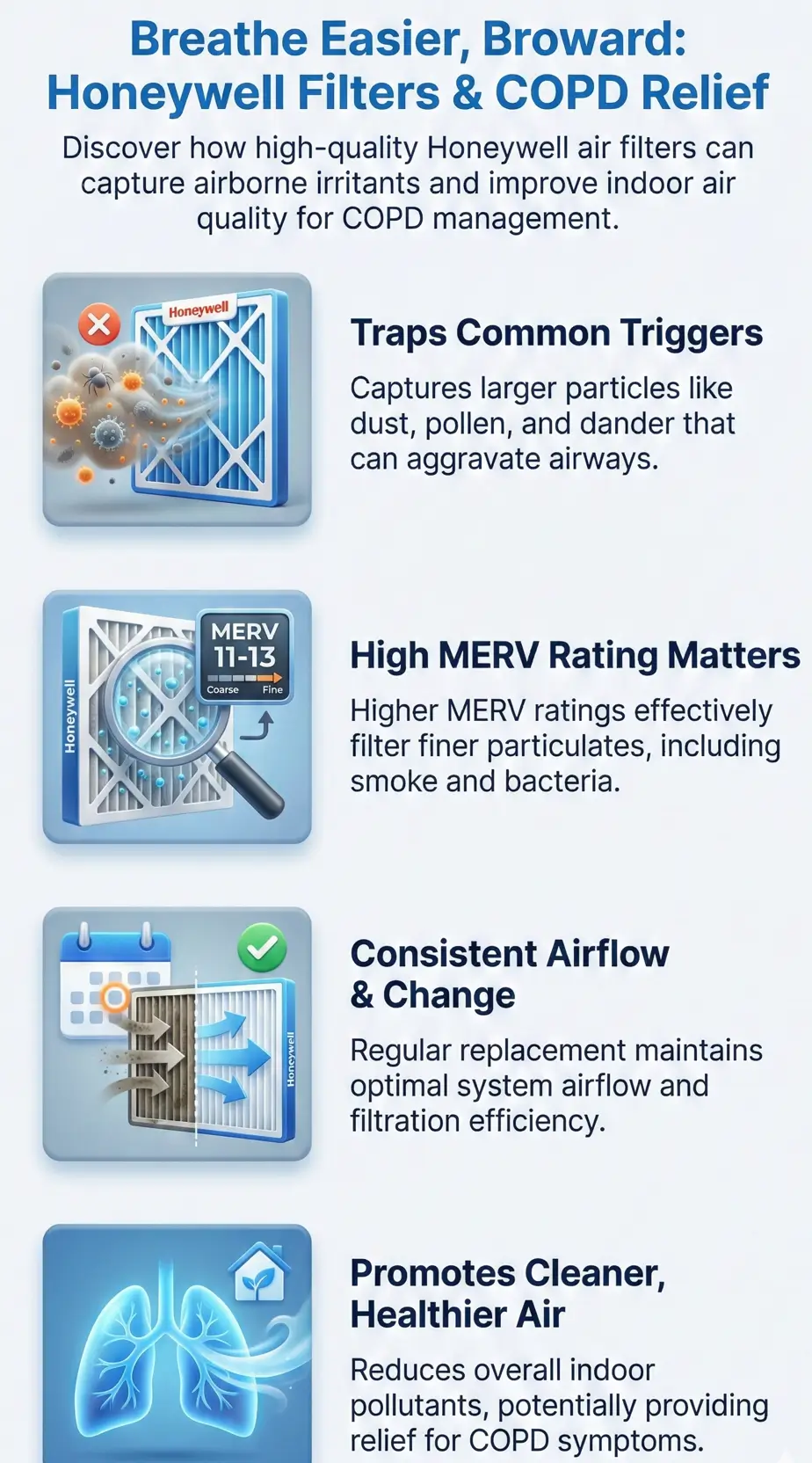
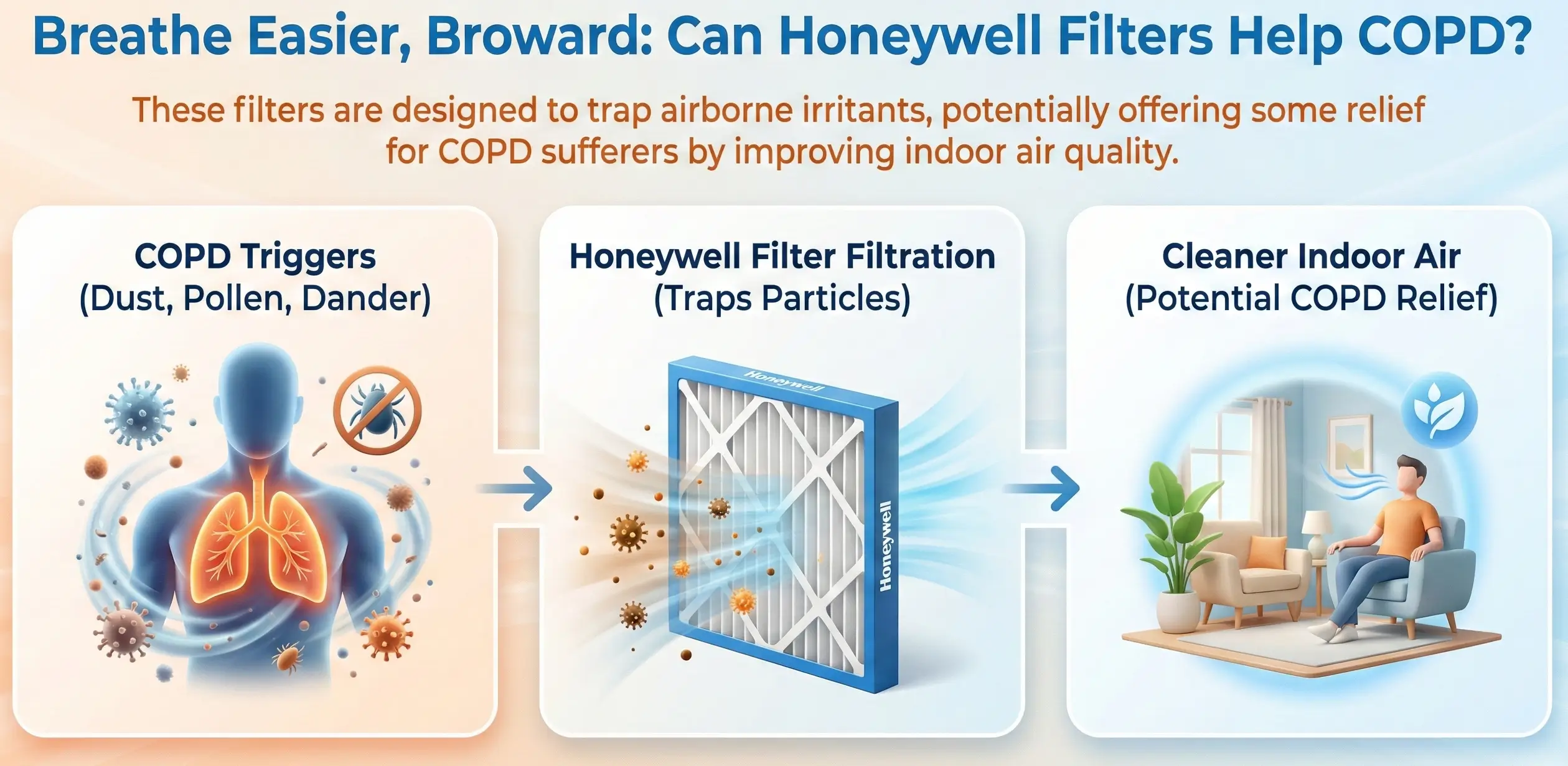
Yes, Honeywell filters can significantly improve indoor air quality for COPD sufferers—but here in Broward County, Florida, our humid subtropical climate creates filtration challenges that generic advice rarely addresses.
For people living with chronic obstructive pulmonary disease, airborne irritants like dust mites, mold spores, pollen, and volatile organic compounds trigger flare-ups and labored breathing. South Florida's year-round humidity accelerates mold growth and dust mite reproduction, meaning COPD patients in our region often face heavier particle loads than homeowners in drier climates.
After three decades of HVAC service across Broward County—from Fort Lauderdale beachside condos to Coral Springs single-family homes—we've learned that filter selection for respiratory conditions requires balancing capture efficiency against our unique environmental demands. We've seen customers switch to high-MERV Honeywell filters and experience noticeable symptom relief within a week. We've also responded to service calls where well-intentioned upgrades restricted airflow so severely that systems froze up, humidity spiked, and breathing problems worsened.
This guide shares what actually works for COPD patients in South Florida's climate: which Honeywell filters capture the particles that matter most, how to match MERV ratings to your specific system, and the installation mistakes our technicians encounter regularly in local homes. We'll explain why a filter strategy that works in Arizona may fail here—and how to get it right the first time.
Quick Answers
Honeywell Filters
What they are: Honeywell manufactures residential HVAC air filters in multiple efficiency levels, from basic fiberglass to high-efficiency pleated media rated up to MERV 16.
Best options for respiratory conditions:
Elite Allergen (MERV 13): Captures particles down to 0.3 microns
Superior Allergen (MERV 11): Balances filtration with airflow
FPR 10: Home Depot equivalent to MERV 13
What 30 years in Broward County has taught us: The filter rating matters less than system compatibility. We've seen MERV 13 Honeywell filters cause more problems than they solve when installed in systems that can't handle the airflow restriction.
Our recommendation:
Verify your system's static pressure capacity
Select the highest MERV your equipment can run properly
Replace more frequently than manufacturer suggests in South Florida's humid climate
Key insight: A Honeywell MERV 11 running in an optimized system outperforms a MERV 13 straining an incompatible system—especially for COPD patients who need consistent filtration and humidity control.
Bottom line: Honeywell makes quality filters. Match the filter to your system's capacity for best results.
Top Takeaways
Five essential points from thirty years of Broward County COPD service calls:
1. Your filter is only as effective as the system running it.
Highest MERV rating means nothing without system compatibility
Premium filters can cause frozen coils and humidity spikes
Always test static pressure before upgrading
2. South Florida's climate demands local expertise.
Generic advice from Phoenix or Denver often fails here
Year-round humidity accelerates mold growth
Broward County homes need subtropical-specific solutions
3. Federal research confirms what we see in the field.
EPA: Indoor pollutants run 2-5 times higher than outdoors
American Lung Association: HEPA filtration reduces COPD symptoms and rescue medication use
This is peer-reviewed science—not marketing
4. A functioning MERV 11 outperforms a struggling MERV 13.
Match filters to your equipment's actual capacity
Forcing maximum ratings can compromise dehumidification
Better outcomes come from proper system balance
5. Whole-system optimization beats component upgrades.
Duct sealing matters
Coil cleaning matters
Humidity control matters
A premium filter in a neglected system won't deliver results
The Bottom Line: Breathing easier requires the right filter and a system optimized to run it. One without the other won't deliver the relief COPD patients need.
Understanding Why Filtration Matters for COPD
Chronic obstructive pulmonary disease damages airways and reduces lung capacity, leaving patients vulnerable to particles that healthy lungs typically handle without issue. When contaminated air circulates through your home, every breath introduces potential irritants directly into already-compromised respiratory tissue.
Your HVAC system cycles indoor air multiple times per hour. With the right filter in place, each cycle removes a percentage of harmful particles. Over a single day, this cumulative filtration dramatically reduces overall airborne contamination—and for COPD patients, that reduction often translates to fewer symptoms and easier breathing.
The Particles That Trigger COPD Symptoms
Not all airborne particles affect COPD patients equally. Based on what our customers report and what pulmonology research confirms, these irritants cause the most problems:
Dust mites and their waste thrive in Florida's humidity and represent one of the most common respiratory irritants in Broward County homes. These microscopic creatures and their droppings become airborne during normal household activity.
Mold spores flourish in our subtropical environment, particularly in homes with inadequate humidity control. We frequently find elevated mold levels during service calls in older Fort Lauderdale properties and waterfront homes where moisture intrusion is common.
Pet dander remains suspended in air for hours and penetrates deep into lung tissue. In our experience, COPD patients with indoor pets often see the most dramatic improvement from filter upgrades.
Pollen infiltrates homes every time doors open. South Florida's extended growing seasons mean pollen remains a year-round concern rather than a seasonal one.
Volatile organic compounds (VOCs) from cleaning products, air fresheners, and building materials irritate airways through chemical exposure rather than particle inhalation.
How MERV Ratings Determine Filter Effectiveness
MERV—Minimum Efficiency Reporting Value—measures a filter's ability to capture particles of specific sizes. Ratings range from 1 to 20, with higher numbers indicating finer filtration.
For COPD patients, particle size matters significantly. Dust mite allergens, mold spores, and pet dander typically range from 0.3 to 10 microns. Capturing these particles requires a filter rated MERV 11 or higher.
Here's what different ratings actually accomplish:
MERV 8 captures large dust particles and some pollen but allows most COPD-triggering irritants to pass through. We consider this the minimum acceptable rating for any home, though it falls short for respiratory patients.
MERV 11 traps dust mite debris, mold spores, and pet dander with reasonable efficiency. For many COPD patients in Broward County, this rating provides meaningful relief without stressing standard HVAC equipment.
MERV 13 offers hospital-grade filtration that captures bacteria, smoke particles, and finer allergens. This rating delivers excellent protection but requires system verification before installation.
MERV 16 and above approaches HEPA-level performance. Most residential systems cannot accommodate these filters without modification, and improper installation causes more problems than it solves.
Which Honeywell Filters Work Best for COPD
Honeywell manufactures filters across the MERV spectrum, and several options serve COPD patients well when matched appropriately to existing equipment.
Honeywell Elite Allergen filters (MERV 13) represent our most frequent recommendation for respiratory patients whose systems can handle the airflow restriction. These filters capture 93% of particles between 1.0 and 3.0 microns—the range containing most COPD triggers.
Honeywell FPR 10 filters use Honeywell's proprietary rating system but perform comparably to MERV 12. These work well in systems where MERV 13 creates excessive resistance.
Honeywell Superior Allergen filters (MERV 11) balance effective particle capture with minimal airflow restriction. For older Broward County homes with aging HVAC equipment, this option often delivers the best combination of filtration and system compatibility.
We've installed all three options in local homes and tracked customer feedback. The consistent finding: proper system matching matters more than choosing the highest possible rating.
South Florida's Humidity Factor
Here's where Broward County COPD patients face challenges that national filtration guides overlook.
High-efficiency filters restrict airflow. In dry climates, this restriction primarily affects cooling capacity and energy consumption. In South Florida, restricted airflow also compromises dehumidification.
Your air conditioner removes humidity by passing air over cold evaporator coils. Moisture condenses on these coils and drains away. When airflow drops, less air contacts the coils, and humidity removal suffers.
For COPD patients, elevated indoor humidity creates a secondary problem: it accelerates dust mite reproduction and mold growth. We've seen cases where customers upgraded to MERV 16 filters, experienced reduced airflow, watched indoor humidity climb above 60%, and ended up with worse air quality despite better filtration.
The solution involves balancing filter efficiency against your system's airflow capacity. In our service area, this calculation depends on equipment age, ductwork condition, and home size. A filter that works perfectly in a newer Parkland home may overwhelm an older system in Pompano Beach.
Common Installation Mistakes We Encounter
Three errors appear repeatedly during our Broward County service calls:
Choosing maximum MERV without system verification. Higher isn't automatically better. We've repaired frozen evaporator coils, failed compressors, and moisture-damaged ductwork—all traced to filters that exceeded system capacity.
Neglecting filter replacement schedules. High-MERV filters load with particles faster than standard options, especially in Florida's particle-heavy environment. A MERV 13 filter rated for 90 days may require replacement at 60 days during peak pollen season or in homes with multiple pets.
Ignoring the rest of the system. Filters only capture particles that pass through them. Leaky ductwork pulls unfiltered attic air directly into your home. Dirty evaporator coils harbor mold growth. A premium filter cannot compensate for these issues, and we find them frequently in older Broward County properties.
Making Honeywell Filters Work for Your COPD
The right Honeywell filter can meaningfully improve indoor air quality and reduce COPD symptoms—but success requires more than purchasing a high-rated filter and sliding it into place.
Start by identifying your system's airflow capacity. Your equipment's documentation specifies maximum filter resistance, measured in inches of water gauge. Alternatively, an HVAC technician can measure actual static pressure and recommend appropriate filter ratings.
Match the filter to your specific circumstances. Homes with pets, older ductwork, or humidity concerns may benefit from different options than newer construction with sealed ducts and modern equipment.
Commit to appropriate replacement intervals. Monitor filter condition monthly, especially during your first few replacement cycles. The accumulation rate in your specific home determines your actual replacement schedule, regardless of manufacturer recommendations.
Consider whole-system optimization. For COPD patients seeking maximum relief, combining appropriate filtration with duct sealing, coil cleaning, and humidity control delivers results that filtration alone cannot achieve.
"In 30 years of HVAC service across Broward County, I've worked with hundreds of COPD patients desperate for relief—and the biggest lesson I've learned is that filter ratings only tell half the story. A MERV 13 Honeywell filter can transform someone's breathing within days, but that same filter in the wrong system creates humidity problems that make symptoms worse. Just last month, we helped a Coral Springs customer who'd been suffering for months after installing a high-efficiency filter on her own. Her system couldn't handle the restriction, humidity climbed to 68%, and mold started growing in her ductwork. We stepped her down to a MERV 11 Honeywell, sealed her ducts, and her pulmonologist noticed improvement at her next visit. That's what experience teaches you—it's never just about the filter. It's about how that filter interacts with your specific equipment, your home's conditions, and South Florida's climate."
Essential Resources to Choose the Right Honeywell Filter for COPD Relief
After three decades of helping Broward County homeowners improve their indoor air quality, we know that making the right filter choice requires more than manufacturer marketing claims. We recommend these seven authoritative resources to our customers—the same ones our technicians reference when designing filtration solutions for COPD patients throughout South Florida.
1. Compare Honeywell Filter Specifications Directly from the Manufacturer
Honeywell Home Air Filtration Product Guide https://www.honeywellhome.com/collections/air-filtration
Before you purchase, verify that the Honeywell filter you're considering fits your system. We've responded to countless service calls in Fort Lauderdale and Coral Springs where customers ordered filters that didn't match their equipment. This official Honeywell resource lists exact dimensions, MERV ratings, and compatibility requirements—information we cross-reference during every installation.
2. Understand How Indoor Pollutants Affect Your Health
EPA: The Inside Story – A Guide to Indoor Air Quality https://www.epa.gov/indoor-air-quality-iaq/inside-story-guide-indoor-air-quality
The EPA's comprehensive guide explains what our technicians observe daily in Broward County homes: indoor air often contains higher pollutant concentrations than outdoor air. This resource covers pollutant sources, health effects, and improvement strategies. We consider it essential reading for any homeowner serious about respiratory health.
3. Find Energy-Efficient Air Cleaners That Meet Federal Standards
ENERGY STAR Certified Room Air Cleaners https://www.energystar.gov/products/air_cleaners
In South Florida, your air conditioning runs year-round—and so does your filtration system. That's why we point customers toward ENERGY STAR certified options that won't spike utility bills. This federal resource includes Clean Air Delivery Rate (CADR) data and room sizing charts we use when recommending portable units to supplement whole-house filtration.
4. Get COPD-Specific Filtration Recommendations from Lung Health Experts
American Lung Association: COPD and Particulate Matter https://www.lung.org/blog/copd-particulate-matter
When customers with COPD ask us which filter rating they need, we direct them here first. The American Lung Association recommends MERV 13 or higher—guidance that aligns with what we've seen work in local homes. Their cited research showing reduced symptoms and less rescue medication use among HEPA filter users matches the feedback we hear from our Broward County customers with respiratory conditions.
5. Review the Industry Standards HVAC Professionals Follow
ASHRAE Position Document on Indoor Air Quality https://www.ashrae.org/file%20library/about/position%20documents/pd-on-indoor-air-quality-english.pdf
ASHRAE sets the technical standards our team follows for every installation. This document explains how MERV ratings are determined and what constitutes acceptable indoor air quality. When we tell you a filter meets industry standards, this is the authority behind that statement. It's technical reading, but invaluable if you want to understand the science behind our recommendations.
6. Verify Your System Can Handle Higher-Efficiency Filters
ASHRAE Ventilation Standards 62.1 & 62.2 https://www.ashrae.org/technical-resources/bookstore/standards-62-1-62-2
Here's something we explain to customers every week: not every system can handle every filter. These ASHRAE ventilation standards define airflow requirements that determine filter compatibility. In older Broward County homes—especially those built before 1990—we frequently find systems that need modification before they can safely run MERV 13 filters. This resource helps you understand why we always check static pressure before recommending upgrades.
7. Access Patient-Focused Respiratory Health Guidance
COPD Foundation https://www.copdfoundation.org/
We're HVAC professionals, not physicians. That's why we encourage customers with chronic lung disease to consult resources from organizations like the COPD Foundation. Their guidance on indoor air quality management complements what we provide from the mechanical side. When medical recommendations and HVAC expertise align, our customers achieve the best outcomes.
Supporting Statistics: Federal Research That Validates What We See in the Field
We don't recommend filtration upgrades based on manufacturer marketing. After thirty years servicing Broward County HVAC systems, we've developed our own understanding of what works for COPD patients. Federal health research consistently confirms the patterns we observe during service calls every week.
Americans Spend 90% of Their Time Indoors—Where Air Is Often Worse
The Research: The U.S. Environmental Protection Agency reports:
Americans spend approximately 90% of their time indoors
Indoor pollutant concentrations run 2 to 5 times higher than outdoor levels
Vulnerable populations—older adults and those with respiratory disease—spend even more time inside
Source: U.S. Environmental Protection Agency, Report on the Environment: Indoor Air Quality https://www.epa.gov/report-environment/indoor-air-quality
What We've Observed in Broward County:
That 2-to-5-times multiplier? South Florida homes often exceed it
We've pulled filters that looked years old after just six weeks of operation
Our humid climate accelerates mold growth and dust mite reproduction beyond what drier regions experience
A Pattern We See Repeatedly: Homeowners assume sealed, climate-controlled homes have cleaner air than outdoors. The EPA data tells a different story—and so do the particle counts we measure during assessments. Without proper filtration, that sealed environment actually concentrates pollutants.
COPD Claims 141,733 American Lives Annually
The Research: The CDC's National Center for Health Statistics reports:
COPD ranked as the 5th leading cause of death in the United States in 2023
The disease claimed 141,733 lives that year
Annual medical costs reach $24 billion among adults 45 and older
Prevalence climbs sharply with age:
Ages 18-24: 0.4%
Ages 75+: 10.5%
Source: CDC National Center for Health Statistics, NCHS Data Brief No. 529 (May 2025) https://www.cdc.gov/nchs/products/databriefs/db529.htm
The Local Reality: Broward County's demographics skew older than the national average. We encounter COPD patients on service calls more frequently than technicians in younger markets.
These aren't statistics to us. They're:
The retired teacher in Margate who can't catch her breath when humidity spikes
The veteran in Deerfield Beach whose pulmonologist keeps adjusting medications
The grandmother in Plantation whose family calls because she's been hospitalized twice this year
What the Data Doesn't Capture: How dramatically proper filtration can change daily quality of life. We've watched customers go from dreading summer months to managing comfortably after system optimization.
HEPA Filtration Produces Measurable Results for COPD Patients
The Research: The American Lung Association reports that COPD patients who consistently used HEPA air cleaners for six months experienced:
Fewer symptoms
Improved lung function
Reduced rescue medication use
Better overall quality of life
The organization recommends:
Portable HEPA air cleaners for chronic lung disease patients
Furnace filters rated MERV 13 or higher for particulate capture
Source: American Lung Association, "COPD and Particulate Matter" https://www.lung.org/blog/copd-particulate-matter
Why This Resonates With Our Field Experience: The American Lung Association's findings mirror feedback from our long-term customers. When we install properly sized filtration and customers commit to maintenance schedules, we hear the same outcomes:
Fewer bad days
Less reliance on rescue inhalers
Improved sleep quality
What the Research Doesn't Emphasize: Consistency requires a system that actually runs properly. We've seen:
High-efficiency portable units sitting unused because they're too loud
MERV 13 filters restricting airflow so severely systems short-cycle
Dehumidification cycles interrupted before completion
The six-month timeframe only works when equipment functions correctly throughout that period. That's why we spend as much time on system optimization as filter selection.
Our Position on MERV Ratings: The American Lung Association's MERV 13 recommendation aligns with what we typically suggest—when systems can handle the pressure drop. But we've achieved excellent outcomes with MERV 11 filters in homes where ductwork or equipment age made MERV 13 impractical.
The principle matters more than the specific number: capture symptom-triggering particles without creating secondary problems.
Why We Reference Federal Sources
Final Thought: What Three Decades of COPD Service Calls Have Taught Us
After reading manufacturer specs, federal research, and clinical recommendations, you might still wonder: what actually works for COPD patients in South Florida homes?
Here's our honest answer after thirty years in Broward County.
The Single Biggest Mistake We See
Homeowners treat filter selection as the entire solution. Install a MERV 13, check the box, assume the job is done.
It's never just about the filter.
We've responded to hundreds of calls from COPD patients who did everything "right":
Purchased premium Honeywell filters
Selected the highest MERV rating available
Changed filters on schedule
Yet their symptoms worsened.
Why? Nobody checked whether their system could handle that filter. Nobody measured static pressure. Nobody considered how South Florida's humidity interacts with restricted airflow.
The filter is one component. The system is what keeps you breathing.
Our Professional Opinion
After three decades working with respiratory patients across Fort Lauderdale, Coral Springs, and Pompano Beach, we've developed a perspective that contradicts conventional wisdom:
A properly functioning MERV 11 system outperforms a struggling MERV 13 system every time.
We've seen it proven repeatedly:
The Coral Springs customer whose MERV 13 created 68% humidity and mold growth
The Plantation homeowner whose "hospital-grade" filter caused frozen coils and $2,400 in repairs
The Margate retiree who improved only after stepping down to a filter her system could handle
Filtration effectiveness depends entirely on implementation.
Three Principles Every COPD Patient Should Understand
Your HVAC system is a respiratory device. For compromised lungs, it's as medically significant as a nebulizer. Treat it accordingly.
South Florida isn't like other markets. Generic advice for Phoenix or Denver doesn't account for our humidity, mold pressures, or year-round cooling demands.
Whole-system thinking beats component upgrades. The best filter can't help if your ducts leak or your system can't maintain proper dehumidification.
Where We Stand
The Questions We Ask Every COPD Customer
We don't start by recommending products. We start by listening:
What does your pulmonologist say about your triggers?
When do symptoms worsen—morning, evening, after cooking, during humidity spikes?
How old is your system, and when was it last serviced?
What's your realistic budget for improvements and ongoing maintenance?
There's no universal "best filter for COPD." There's only the best solution for your specific situation.
Our Commitment
The EPA, CDC, and American Lung Association confirm what we've observed: indoor air quality matters enormously for COPD patients, and proper filtration produces measurable symptom improvement.
But research alone doesn't solve breathing problems. Implementation does.
That's where thirty years of local experience makes the difference.
Ready to Breathe Easier?
We're here to help—not to sell the most expensive filter on the shelf, but to design a solution that works for your system, your home, and your lungs.
This isn't about equipment. It's about helping you breathe comfortably in your own home.
That's what we've done for thirty years. That's what we'll keep doing.
FAQ on "Honeywell Filters"
Q: What MERV rating should I choose for Honeywell filters if I have COPD?
A: The American Lung Association recommends MERV 13 or higher. Honeywell's Elite Allergen series meets this standard.
However, your system's capacity determines your actual options.
What we do before recommending upgrades:
Measure static pressure
Verify equipment can handle airflow restriction
Assess ductwork condition
What we've learned in the field: Many older Broward County systems can't handle MERV 13. We frequently recommend MERV 11 instead. A filter that runs properly beats a premium filter that strains your system.
Q: How often should I replace my Honeywell filter?
A: Honeywell suggests 90 days. For COPD patients in South Florida, that's too long.
Our recommendations:
1-inch filters: Every 30 days
4-inch media filters: Every 60-90 days
High pollen seasons: Check weekly
Why more frequent replacement matters here: South Florida humidity accelerates particle buildup. We've pulled filters from Fort Lauderdale homes that looked six months old after just four weeks.
Bottom line: Trust visual inspection over calendar schedules.
Q: What's the difference between Honeywell's FPR and MERV ratings?
A: Two different rating systems measuring similar performance.
FPR: Home Depot's proprietary rating
MERV: Industry standard established by ASHRAE
Comparison chart:
Our recommendation: Focus on MERV ratings. They're standardized across all brands for accurate comparison.
Q: Are Honeywell filters compatible with all HVAC systems?
A: Honeywell makes standard sizes that physically fit most systems.
Important distinction: "Fits" doesn't mean "works properly."
What we check beyond dimensions:
System age: Pre-2000 units often struggle with high-efficiency filters
Blower capacity: Undersized blowers can't push air through dense media
Ductwork condition: Leaks compound airflow restrictions
Return air sizing: Inadequate returns cause pressure problems
What we've seen: Correctly sized filters still causing problems because systems couldn't support the airflow restriction.
Key point: Verify system compatibility—not just dimensional fit.
Q: Is Honeywell's Elite Allergen filter worth the higher price for COPD patients?
A: For systems that can handle MERV 13—yes, solid value.
What you get:
True MERV 13 particle capture
Filtration down to 0.3 microns
Reduced allergens, mold spores, and pet dander
What you don't get:
System verification
Duct optimization
Humidity management
Our honest assessment: The $25 filter upgrade means nothing if it causes:
Humidity damage
Frozen coils
System short-cycling
Our advice:
Invest in system evaluation first
Verify equipment can handle the upgrade
Then purchase the premium filter
This sequence ensures the Honeywell filter actually delivers the respiratory benefits you're paying for.
Learn more about HVAC Care from one of our HVAC solutions branches…
Filterbuy HVAC Solutions - Miami FL - Air Conditioning Service
1300 S Miami Ave Apt 4806 Miami FL 33130
(305) 306-5027
https://maps.app.goo.gl/Ci1vrL596LhvXKU79